Are you still a gadget?

Can one be critical, even apparently pessimistic, while still remaining optimistic? Perhaps. Jaron Lanier, the pioneer of virtual reality, is the living proof, and he manages that balance remarkably well. His book You Are Not a Gadget is an essential reading, even if it’s been 16 years from its publication. Arrived on the booklshelves in 2010, it opened the second decade of the 21st century with a reflection on the technological developments of the previous thirty years, accompanied by advice on how to face and survive our deeply digitalized era. The analysis is accessible, though it calls for clarification and, above all, deep reflection.
We have reached a point where our lives are almost permanently dependent on machines, on bits, and on any device capable of simplifying daily routines and tasks. The search engines in our browsers seem to know better than we do what we are looking for; AI now leeches on and dooms nearly every platform; smartphones have become extensions of our bodies, almost like prosthetic tools on which a large share of our activities depends. We move faster, appear smarter, and juggle multiple tasks all at once, yet this constant acceleration and sensory overload may also be blinding us, making it harder to distinguish the real from the artificial.
But how did we arrive here? Did the pioneers foresee the direction, or perhaps the deviation, that computer and network technology would eventually take? Probably not. Or perhaps they did, though not to the extent that now defines everyday life. Lanier frequently invokes the idea of the “hive mind”, the noosphere: an extended network of people who gradually become one collective entity at the expense of individual identity. The massification of the online population is, in his view, problematic because it suppresses individual intelligence. For this reason, he resists digital trends that encourage large numbers of people to prioritize machines over humanity. Individualism, for him, remains crucial. He also observes that online culture is filled with rhetoric about the supposed path toward a better world, yet it increasingly moves in an anti-human direction. And I would fucking agree on that.
Perhaps the situation would less tragic if the virtual world had not come so close to overtaking the real one. Today the two appear intertwined, forming a symbiosis that seems irreversible. This was not the case during the early days of the Internet, when it was often used with a certain sense of responsibility and curiosity. In those years, people collaborated on projects that could nurture personal growth and collective progress. The enthusiasm surrounding the World Wide Web created by Tim Berners-Lee was genuine, partly because many early users came from academic environments and brought with them ideas, research, and a clear separation between online and offline life.
Douglas Rushkoff has also written about this shift, pointing out that the underlying issue often comes down to time. In the 1990s, connecting to the Internet was slow; modems tied to telephone lines could not compare with today’s broadband infrastructure. As a result, interactions between users were slower, more cautious, and often more thoughtful. People reflected carefully on what they would write in forums or emails. Anonymity was less central, mashups were not required to sustain dialogue, and the relationship between humans and machines was clearer: people controlled the tools, not the other way around.
The future, however, carries unsettling predictions, even more than ever. Lanier speaks about the “left behind,” a scenario in which technological development becomes so advanced that human beings risk becoming obsolete. Sounds like AI platforms such as the fucking ChatGPT? Yeah, exactly. Tech dudes work relentlessly to design increasingly sophisticated softwares that may ultimately improve machines more than it improves the lives of the people who use them. One day, Lanier suggests, these systems could evolve into forms capable of understanding humans better than humans understand themselves. A telling example occurred when Garry Kasparov, widely considered the greatest chess player in the world, was defeated by a computer. That moment symbolized, for many observers, the beginning of a shift in which humans sometimes lower their intellectual expectations so that machines can appear more intelligent. Today, it is not uncommon to encounter situations in which an AI system seems smarter than the person using it. And the scary thing is many people stopped using critical thinking and put too much faith and trust in AI bots.
So how can we find a meaningful alternative when our era appears to be governed by four digital horsemen: social media, artificial intelligence, the cloud, and the rhetoric of absolute freedom of speech? Social platforms and the constant invocation of free expression often make us less thoughtful and more reactive, sometimes reducing discourse to trolling rather than dialogue. The world of AI can create the illusion that knowledge is instantly accessible without effort, weakening empiricism and deeper study. Cloud infrastructures transform our personal belongings into streams of data stored somewhere in the digital ether, always within reach yet increasingly abstract - nowadays even ridiculously expensive behind a paywall. At the same time, much of what we do online consists of posting content that rarely generate anything new. Yet apparent uselessness can be entertaining, and if it goes viral, even more so, for better or worse. My only comment on this is: BRAIN ROT. If you know, you know.
Another issue Lanier addresses, alongside several other thinkers, concerns copyright. Broadly speaking, two schools of thought confront each other. One emerges from the open-source tradition, while the other supports a range of licenses designed to protect the labor and creativity of individuals. Choosing between the two is not straightforward. Considering the early Internet, which developed in a relatively open environment, it may seem illogical to apply strict licensing to content that exists as freely replicable bits. On the other hand, many people would fucking go ballistic if their work or intellectual property was taken and redistributed without consent.
A possible solution was proposed by Ted Nelson, whose ideas Lanier often supports. Nelson suggested that the best way to protect both the digital economy and copyright would be to centralize content: every work, whether a book, song, or film, would exist online as a single official digital copy accessible to everyone for a reasonable fee. In theory, such a system could function efficiently, but reality is much more depressing. Today it is difficult to imagine a system immune to hacking or circumvention, especially when it comes to endless subscriptions. A well-known example involves the transition of Adobe software to a cloud-based subscription model. Since 2013, the Creative Suite has evolved into Creative Cloud, requiring monthly payments that many users feel exceed any reasonable threshold. Criticism was inevitable, and the persistence of cracked versions reflects ongoing tensions between access, cost, and control.
Digital culture has taken a firm hold on us. Personally, I still believe that reading authors who have reflected deeply on these transformations remains extremely valuable, even when some might consider their work outdated. Thinkers such as Lanier, Rushkoff, Sherry Turkle, or Geert Lovink offer some food for thought that help illuminate the moment we are living through, even if the year is now 2026 and not 2014.
At the same time, listening to the voices of those who helped build the digital world can leave one suspended in a kind of intellectual limbo. I often find myself there as well. For example, when asked what I think about Richard Stallman and his role in the open-source movement, I hesitate. More often than not, I end up observing events from both sides, weighing the positive and negative aspects without committing to a clear position.
Some certainties remain, however, and they resonate with arguments developed by Rushkoff in Program or Be Programmed. His reflections, like Lanier’s, illuminate the darker sides of digital evolution, aspects that genuinely send some shivers down the spine and provoke deeper thought. After all, what is the point of using the Internet merely as a gadget, especially one that risks becoming such a cancer to us? Both authors argue that the Web’s evolution has, in some ways, stalled, leaving us circling within systems and tools whose full potential we struggle to realize. It is a dog chasing its own tail. The most troubling part is that we often remain trapped in the less constructive side of the network without noticing it: moving our lives onto social platforms, endlessly scrolling and compulsively refreshing feeds, checking and using our phones as if personal success depended on them. Added to this is the growth of anonymity and the rapid spread of misinformation, which in recent years seems to have gained alarming prominence.
How is it possible that people believe certain claims without even checking a single reliable source? Could this reflect a lowering of intellectual abilities? Possibly. The absence of a rigorous academic approach to knowledge may prevent many people from developing the critical perspective necessary to navigate computational culture.
Yet focusing only on the negative aspects of the network would be shortsighted. Despite its many moral ambiguities and darker tendencies, the digital world still contains something valuable. This is why my relationship with it often oscillates between affection and painful frustration. I know that somewhere out there are people who resist superficiality and banality, individuals who try to use technology thoughtfully and creatively, producing meaningful work in art and design, for example. They remain firmly pro-humanity, pro-progress, and supportive of technology that serves a genuine purpose, while also opposing exploitation and the erosion of human intelligence.
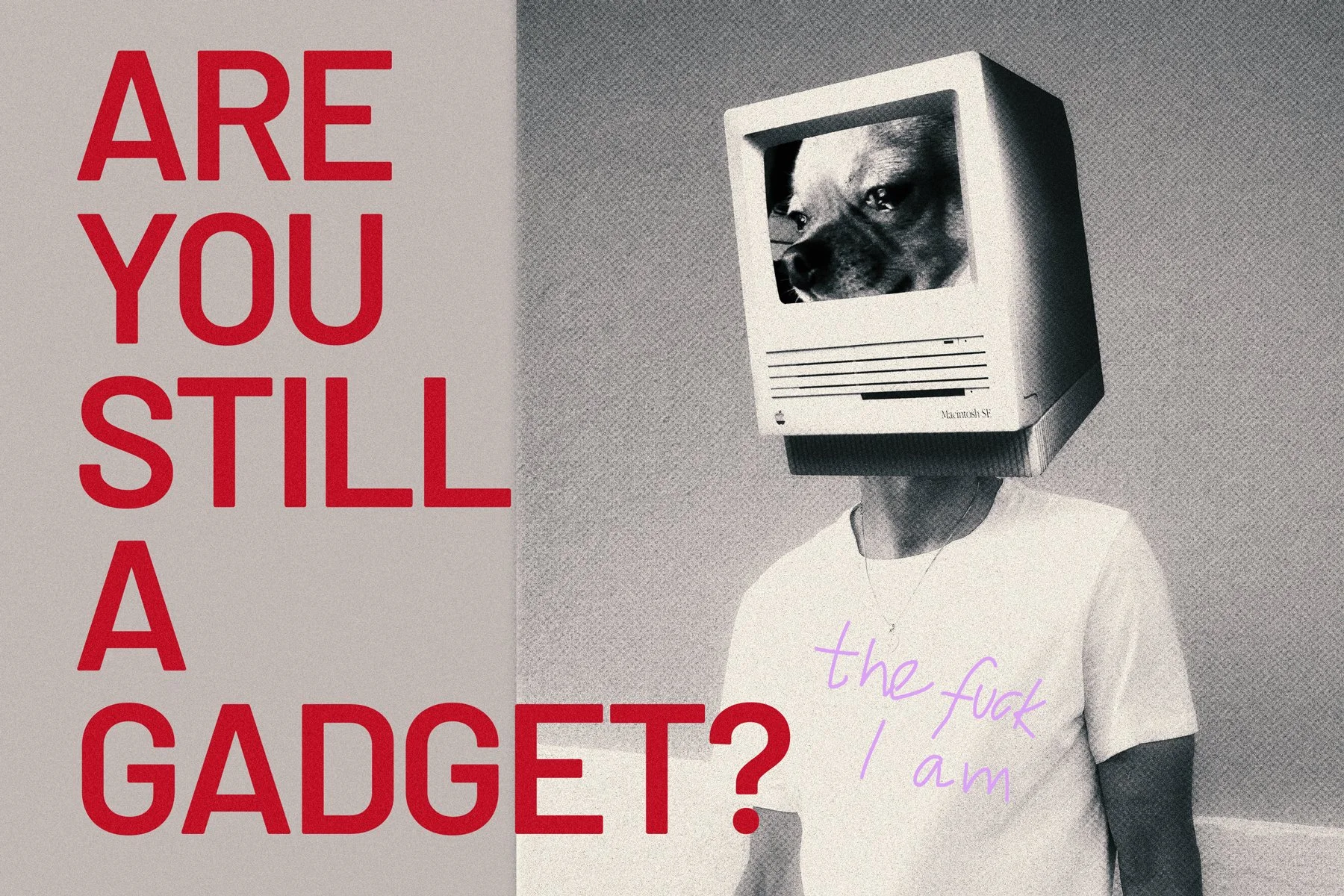
To wrap this up, let’s do a collective reflection here. What should we do? And you… Are YOU still a gadget?
The most sensible strategy for engaging with new media and tools lies in balancing real and virtual life. We need a clearer separation and better organization of our time, allowing us to remain fully human rather than drifting toward a hybrid existence shaped entirely by technology and figures such as Sam Altman and his latest unhinged AI vomit and visions about the future in which only billionaires and artificial intelligence exist. At the same time, we must also be mentally prepared for the final stage of symbiosis between humans and machines, while continuing to cultivate intellectual growth. Without that effort, we risk evolving technologically while stagnating intellectually, without considering the real consequences that will affect us and the planet that we live on.
This entry has been written without any AI aid.
The original version of the article is the one I wrote for my old blog, primitividelfuturo.weebly.com. It has been translated from Italian and updated since.